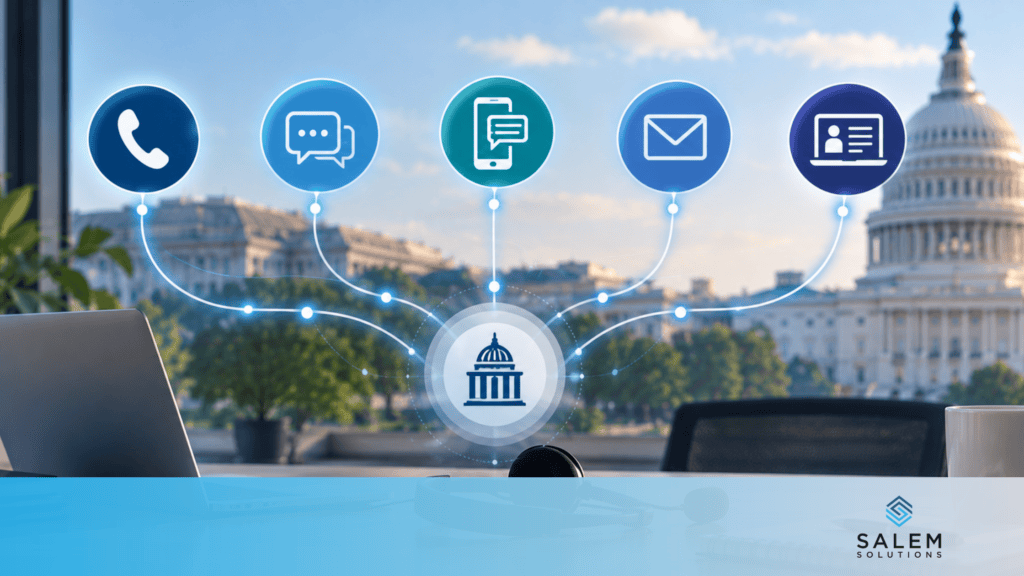
Multichannel federal contact centers are no longer defined by the phone queue.
Citizens may begin on a website, move to chat, receive an SMS update, call when the issue becomes more complicated, and return to a digital portal to complete the transaction.
Federal buyers are increasingly designing service delivery around that reality. Current acquisition activity includes voice, chat, SMS, self-service, automation, analytics, and integrated customer experience capabilities rather than treating every channel as a separate operation.
For contractors, the shift changes more than the technology stack. It changes how agents are trained, how work is routed, how performance is measured, and which workforce skills matter.
A modern multichannel federal contact center needs people who can deliver the same accurate service whether the interaction arrives through a headset, a browser, or a text message.
What Is a Multichannel Federal Contact Center?
A multichannel federal contact center gives customers more than one way to interact with a government service.
Those channels may include phone, email, web chat, SMS, digital self-service, correspondence, or other service pathways depending on the agency and program.
CMS offers a useful federal example. Its Contact Center Operations procurement describes customer service across multiple channels, including telephone, email, written correspondence, TDD/TTY, and web chat.¹
The objective is access.
A person who cannot resolve an issue online may need the phone. Someone looking for a simple answer may prefer chat. A text can confirm an appointment or alert a customer before a callback without requiring another live interaction.
The workforce has to be designed around those different behaviors.
That is where multichannel strategy becomes an operational issue rather than simply a technology decision.
What Is the Difference Between Multichannel and Omnichannel?
The terms are related, but they describe different levels of integration.
A multichannel contact center offers several channels. A customer may be able to call, email, chat, text, or use a self-service tool.
An omnichannel contact center connects those channels so the experience and information can move with the customer.
The difference becomes obvious when someone changes channels.
In a multichannel environment, a customer may explain the problem through chat, then call and have to start again because the phone agent cannot see the earlier interaction.
In a stronger omnichannel environment, the second agent can see the previous contact, understand what has already happened, and continue the service journey.
Federal buyers are explicitly looking at that level of integration.
An October 2026 VA market research notice describes an existing environment processing approximately 125,000 to 150,000 contacts each month across voice, chat, SMS, and self-service. VA is asking industry how those capabilities could evolve toward an omnichannel service model with expanded automation and integration across customer experience, knowledge management, routing, identity verification, workforce management, and analytics.²
That is a much broader requirement than adding another inbox.
Read More: Federal Customer Experience: Why Federal Contact Centers Are Under Pressure
The Five Channels Shaping Modern Federal Contact Centers
Not every agency will use the same channel mix, but five categories now matter in federal contact center planning.
1. Voice and IVR
Voice remains critical, particularly for complex, sensitive, or high-consequence interactions.
Modernization is changing what happens before an agent answers.
Interactive voice response, intelligent routing, callback, voice recognition, and automated assistance can move simpler inquiries away from live agents or route customers to the right skill group faster.
GSA’s Automated Contact Center Solutions acquisition category includes IVR, callback, voice and speech recognition, text-to-speech, and other technologies intended to help agencies respond to inquiries more efficiently.³
For the workforce, better voice automation does not necessarily remove the need for agents.
It can change the calls that reach them.
If routine interactions are resolved earlier in the journey, live agents may receive a higher concentration of complicated cases, exceptions, escalations, or customers who have already tried another route.
That can raise the skill requirement even when total call volume falls.
2. Web Chat
Chat gives customers real-time support without requiring a phone conversation.
For federal programs, it can be especially useful when someone is already working through a website, application, or online service and needs help without leaving the digital experience.
Federal contact center procurements already treat web chat as an established service channel. CMS includes it within its multichannel Contact Center Operations requirements, while GSA’s acquisition offerings include chatbot and automated contact center capabilities.
Chat also changes productivity assumptions.
An experienced agent may be able to manage more than one conversation at a time, but concurrency is not free capacity. Complex questions, authentication, documentation requirements, and sensitive information can reduce how many conversations an agent can responsibly handle.
Workforce planning needs to account for the actual work rather than assuming every chat agent can simply handle several customers simultaneously.
3. SMS and Text Messaging
Federal agencies can use SMS, but the use case, consent model, privacy requirements, and security boundaries matter.
The IRS, for example, currently uses opt-in text messages for specific services, including Taxpayer Assistance Center appointment updates, news subscriptions, and customer callback reminders. The agency also makes clear that it does not use text messages to request personal financial information, payments, passwords, or account credentials.⁴
VA similarly uses text messaging for healthcare appointment reminders, confirmations, cancellations, and certain pre-check-in activities.
Those examples show where SMS is particularly useful: short, timely, transactional communication.
For contact center programs, text can reduce avoidable calls by answering a different question before the customer needs to make one.
Is my appointment still happening?
When will someone call me back?
Has my scheduled interaction changed?
SMS should therefore be evaluated as part of the wider customer journey, not simply as another queue for agents to monitor.
4. Email and Secure Digital Messaging
Email remains useful for interactions that do not require an immediate response and for communications where customers may need to provide more detail.
It also creates a different workforce pattern.
Phone and live chat create synchronous demand. Email allows work to be queued and handled over a longer service window.
That gives workforce planners more flexibility, but it introduces its own quality requirements.
Written interactions need accuracy, clarity, appropriate tone, documentation discipline, and strong knowledge-management support. Agents who perform well on voice may still need additional coaching before handling written channels because the communication skill is different.
For sensitive programs, conventional email may also be unsuitable for certain information, which makes secure messaging or authenticated digital environments more appropriate.
Channel selection needs to follow the service being delivered.
5. Digital Self-Service
Self-service sits alongside agent-assisted channels because it can determine how much work reaches the contact center.
FAQs, knowledge bases, portals, virtual assistants, automated status tools, and well-designed digital forms can allow customers to complete simpler tasks without an agent.
Federal policy continues to push service delivery in this direction.
The 21st Century Integrated Digital Experience Act and OMB’s digital-service guidance established requirements around modernizing federal websites and digital services. Federal digital experience guidance connects service delivery with digital access, customer understanding, accessibility, and reducing unnecessary burden.⁵
The workforce implication is important.
Self-service changes demand rather than simply eliminating it.
Customers who successfully resolve simple issues disappear from the assisted queue. The cases that remain may require more judgment, troubleshooting, empathy, or program knowledge.
The agent role becomes more specialized as the digital front door improves.
Where Federal Buyers Are Investing in Contact Center Modernization
The strongest signal is not a single technology.
Federal investment is moving toward connected service delivery.
GAO reviewed High Impact Service Provider action plans and found that digital improvements accounted for roughly 67 to 71 percent of planned improvement actions each year from 2023 through 2025. The review also examined agencies’ efforts to improve existing services, collect customer data, and use customer journey information to guide improvements.⁶
Contact center acquisition activity points in the same direction.
Chat, Automation, and AI-Assisted Service
GSA’s Automated Contact Center Solutions scope includes chatbots, IVR, callback, robotic process automation, voice recognition, email delivery, and related technologies.
Federal buyers are also exploring AI-enabled support capabilities, including virtual assistants, automated responses, and tools that can help agents retrieve information or resolve customer requests more efficiently.
The investment direction is clear: federal buyers are looking for ways to resolve more interactions efficiently while improving the experience around the contacts that still need human support.
SMS and Proactive Communication
The IRS and VA demonstrate how text messaging is already being used for reminders, scheduling, callbacks, and service updates.
SMS becomes particularly valuable when proactive communication can prevent a contact.
The operational value is not simply that an agency has a text channel. It is that the program understands where a text can remove friction from the service journey.
Journey Mapping and Service Design
Federal CX work increasingly examines the full path a customer takes through a service.
Journey mapping helps agencies understand where customers encounter unnecessary steps, repeated requests for information, confusing instructions, or breakdowns between digital and assisted channels.
That changes the contact center conversation.
If customers repeatedly call because a form is confusing, adding agents treats the volume.
Fixing the confusing step addresses why the volume exists.
For federal buyers, mature contact center modernization connects workforce data with the wider service journey.
Accessibility
Channel expansion also creates accessibility obligations.
Section 508 requirements apply broadly to federal information and communication technology. Section508.gov guidance specifically includes help desks, call centers, training services, and automated self-service support within ICT support-service requirements and requires those services to accommodate the communication needs of people with disabilities.⁷
A new chat tool, self-service portal, or digital support channel therefore cannot be evaluated only on convenience and throughput.
Accessibility belongs in the requirement from the beginning.
Read More: ADA & Accessibility in Federal Contact Centers: What Compliance Really Requires
Why Multichannel Federal Contact Centers Require a Different Workforce Model
Adding channels changes the work.
A voice-heavy workforce is typically scheduled around call arrival patterns, average handling time, occupancy, and queue performance.
Multichannel environments introduce different demand profiles.
- Chat can involve concurrent interactions.
- Email creates backlog rather than a live queue.
- SMS may generate short transactional contacts.
- Voice increasingly absorbs more complicated cases.
- Self-service can shift the mix again by removing simpler inquiries before they reach an agent.
- The staffing model has to distinguish those workloads.
- Training also changes.
Programs need to decide whether agents will specialize by channel or work across several.
A strong phone agent may need written-communication training before moving into chat. A digital agent may need different escalation procedures. Agents working across channels need one reliable knowledge base so the answer does not change depending on where the customer asks the question.
Supervisor and QA models need to follow.
Evaluating a phone call is different from reviewing a three-message SMS exchange or a live-chat conversation involving several simultaneous sessions.
Multichannel expansion therefore creates a workforce-design requirement alongside the technology requirement.
Read More: Federal Contact Center QA Programs: Why They Fail
Three Multichannel Mistakes Federal Contact Centers Still Make
Treating Every Channel as a Separate Operation
Phone has one team, chat has another, or email sits somewhere else.
The agency technically offers multiple channels, but the customer experience remains fragmented.
A stronger model connects interaction history, knowledge, escalation pathways, and performance information across channels where the program and technology allow it.
Adding Channels Without Redesigning Staffing
Turning on chat does not create chat capacity.
Neither does launching SMS, expanding email, or adding a new digital-service feature.
Every new assisted channel creates forecasting, scheduling, training, QA, supervision, and reporting requirements.
Without those changes, modernization can redistribute the queue rather than improve the service.
Measuring Channels Instead of Journeys
A phone team may hit its SLA while customers continue calling because the digital experience failed earlier.
A chat program may have fast response times while customers still have to switch to voice to complete the task.
Channel-level metrics matter, but they do not explain whether the customer accomplished what they came to government to do.
That is why journey mapping and cross-channel data are becoming more valuable in federal CX planning.
How Should Federal Buyers Evaluate a Multichannel Contact Center Proposal?
A federal buyer should look beyond the number of channels listed in the solution.
A stronger proposal should explain:
How channels connect. Can a customer move from one channel to another without losing context?
How the knowledge layer works. Are agents, digital tools, and self-service experiences drawing from consistent information?
How work is routed. Can interactions reach people with the right skills based on channel, complexity, language, or program need?
How staffing changes by channel. Does the workforce model account for different concurrency, handling, backlog, and scheduling patterns?
How accessibility is built in. Are the proposed technologies and support processes designed to meet federal accessibility requirements?
How privacy and security change by channel. What information can safely be handled through SMS, chat, email, or unauthenticated environments?
How performance is measured across the journey. Does reporting show only individual queue performance, or can the program understand what happened when customers moved between channels?
Technology determines what the platform can do.
Workforce design determines whether those capabilities become a reliable public service.
Read More: The Post-Award Transition Playbook for Federal Contact Centers
How Salem Solutions Supports Multichannel Federal Contact Center Workforces
Salem Solutions supports federal contact center contractors with the workforce capacity behind changing service models.
As programs expand beyond voice, that can mean sourcing agents with strong written communication skills, bilingual capability, digital-service experience, program knowledge, or the ability to work across multiple interaction types. It also means maintaining enough pipeline depth to support channel growth, peak demand, attrition, and changes in how work is distributed.
Salem does not need to be the technology integrator to understand what modernization does to the workforce requirement.
For primes building the next generation of federal contact center operations, channel strategy and workforce strategy need to move together.
Expanding your federal contact center beyond voice? Talk to us about building the workforce capacity behind your multichannel service model.
References
- Centers for Medicare & Medicaid Services, “Contact Center Operations,” SAM.gov, June 2024. https://sam.gov/opp/b501f84807294c10aa2a33dffed8c744/view.
- U.S. Department of Veterans Affairs, “Contact Center Modernization Request for Information,” SAM.gov, October 2026. https://sam.gov/opp/0b4d9d4eaec34aca836c80662ae6ce73/view.
- U.S. General Services Administration, “Automated Contact Center Solutions,” GSA, accessed October 2026. https://www.gsa.gov/technology/it-contract-vehicles-and-purchasing-programs/multiple-award-schedule-it/automated-contact-center-solutions.
- Internal Revenue Service, “Text Messages from the IRS,” IRS, accessed October 2026. https://www.irs.gov/privacy-disclosure/text-messages-from-the-irs.
- Office of Management and Budget, “M-23-22: Delivering a Digital-First Public Experience,” September 22, 2023. https://www.whitehouse.gov/wp-content/uploads/2023/09/M-23-22-Delivering-a-Digital-First-Public-Experience.pdf.
- U.S. Government Accountability Office, “Federal Customer Experience: OMB Can Better Assess the Improvement Efforts of High Impact Service Providers,” GAO-25-107652, July 28, 2025. https://www.gao.gov/products/gao-25-107652.
- U.S. General Services Administration, “Accessibility Requirements Tool (ART): Requirements Statements by ICT,” Section508.gov, accessed October 2026. https://www.section508.gov/tools/list-of-art-requirements/.